Why x402 fits agent commerce compliance
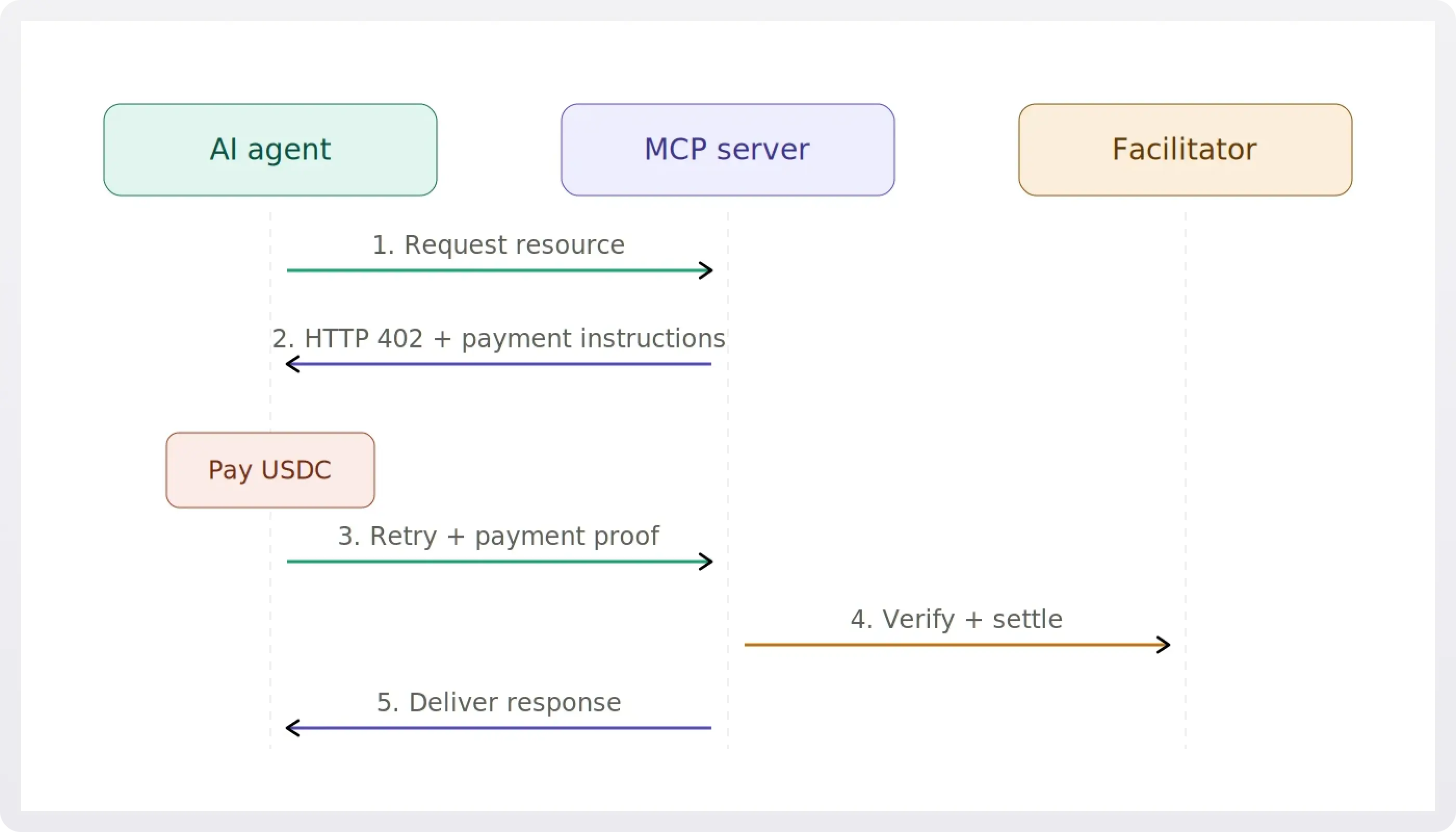
The traditional web was built for free content, but machine-to-machine commerce demands a payment layer. HTTP 402, historically dormant, is now the technical foundation for agent commerce. It allows AI agents to pay for data, verification, and compute directly. For KYC and AML checks, this means the endpoint itself becomes the gatekeeper. An agent cannot proceed without a successful payment, which triggers the compliance check.
This model solves the friction of manual billing. Stablecoins like USDC provide the settlement layer. When an agent calls an x402 endpoint, the transaction is immediate. The verification result is returned only after the stablecoin transfer is confirmed. This creates a tight loop between payment and regulatory compliance.
Official documentation from Coinbase Developer Documentation confirms that x402 enables APIs to charge buyers and AI agents directly. This integration is critical for high-stakes compliance workflows. By embedding the payment into the HTTP response, you ensure that only verified, paid interactions reach your backend.
The convergence of stablecoins and regulatory clarity has created the conditions for this activation. As noted by Braumiller Law, the x402 protocol provides a legal framework for internet-native stablecoin payments. This legal backing, combined with the technical simplicity of HTTP 402, makes it the standard for machine-to-machine compliance.
For developers, this means a shift in architecture. You no longer need a separate payment gateway for KYC fees. The endpoint handles both the financial and regulatory handshakes. This reduces latency and simplifies the agent's decision-making process. The agent pays, receives the KYC result, and proceeds. It is a seamless, automated compliance loop.
Set up x402 payment middleware
To route KYC or AML checks through an x402-enabled API, you first need to establish a reliable payment middleware layer. This middleware acts as the bridge between your compliance logic and the underlying blockchain, ensuring that every verification request is backed by a valid payment intent. Without this foundation, your agents cannot prove they have paid for the data they are about to access.
Start by installing the official SDKs from providers like Coinbase Developer Platform (CDP) or Concordium. These libraries handle the heavy lifting of constructing the Authorization header, which contains the signed payment message required by x402 endpoints. Coinbase’s quickstart guide provides the exact dependency versions needed for Node.js or Python environments. Similarly, Concordium’s documentation details how to integrate zero-knowledge proofs (ZKPs) to satisfy KYC requirements without exposing raw user data.
Note: Always pin your dependency versions to the latest stable releases provided by Coinbase or Concordium. Using outdated middleware can lead to signature verification failures when endpoint protocols evolve.
Once the dependencies are installed, configure your middleware to intercept outgoing API calls. The middleware should attach the payment signature to the request header before the call reaches the KYC provider. This ensures that the provider receives a valid x402 token, which validates the payment and triggers the compliance check. If the signature is missing or invalid, the endpoint will reject the request, preventing unauthorized access to sensitive data.
Integrate KYC verification logic
Embedding KYC and AML checks into your payment flow transforms the x402 protocol from a simple micropayment gateway into a compliant compliance layer. Instead of treating verification as a separate, offline administrative task, you can gate API access directly behind the payment. This ensures that only verified identities can trigger sensitive endpoints, effectively merging financial transaction logic with regulatory requirements.
The integration follows a sequential workflow where the client must satisfy both the payment requirement and the identity verification state before receiving a response. This approach reduces latency in fraud detection and ensures that your x402 endpoints for KYC/AML checks adhere to strict regulatory standards without requiring complex middleware.
Before routing requests, ensure your backend validates the user's KYC status. This involves checking against your identity provider or a zero-knowledge proof verifier. The x402 endpoint should reject unverified requests with a specific error code that prompts the client to complete verification or payment first. This step establishes the legal and technical foundation for the interaction.
Modify your API handler to require a valid x402 payment header alongside a valid KYC token. The server must verify the payment signature and then check the user's verification status. If either condition fails, the endpoint returns a 402 Payment Required or a 403 Forbidden error, depending on which prerequisite is missing. This dual-gate ensures that compliance is a prerequisite for API access.
To protect user privacy while maintaining compliance, integrate zero-knowledge proofs (ZKPs). Instead of sending raw PII (Personally Identifiable Information) to your API, the client sends a cryptographic proof that they have passed KYC checks. This allows your x402 endpoints for KYC/AML checks to verify legitimacy without storing sensitive data, significantly reducing your liability and regulatory burden.
Ensure your system logs all verification attempts and payment transactions for audit trails. Compliance officers need a clear record of who accessed what data and when. Integrate these logs with your existing AML monitoring tools to flag suspicious patterns. This step closes the loop, ensuring that your integration is not just functional but also auditable and defensible.
| Feature | Static KYC Check | x402-Gated Access |
|---|---|---|
| Latency | High (offline verification) | |
| Latency | Low (real-time validation) | |
| Cost | High (manual review) | |
| Cost | Low (automated) | |
| Compliance Coverage | Partial | Full |
Structure payment schemes for access
When building x402 Endpoints for KYC/AML Checks guide integrations, choosing the right billing model is a foundational decision. You are essentially deciding how to price the computational cost of identity verification. The x402 protocol supports two primary approaches: fixed-price verification using the exact header and dynamic, volume-based billing using upto.
Fixed-price verification with exact
The exact model works best for standardized, low-volume checks. You set a precise payment amount in the x-pay header before the request is sent. This is ideal for simple identity proofs where the cost is predictable.
| Feature | Detail |
|---|---|
| Header | x-pay: exact=0.05 |
| Best For | One-off checks, startups |
| Complexity | Low |
This approach mirrors traditional API pricing where you know the cost per call. It is straightforward to implement and easy for compliance officers to track in real-time. However, it requires upfront capitalization for every transaction.
Dynamic billing with upto
For high-volume operations, the upto model offers flexibility. Instead of paying a fixed amount per request, you authorize a maximum limit. The actual charge is determined after the verification is complete, based on the complexity of the check. This is crucial for AML workflows that may require deeper investigation for high-risk users.
| Feature | Detail |
|---|---|
| Header | x-pay: upto=0.50 |
| Best For | Enterprise, high-volume |
| Complexity | Medium |
This model aligns costs with value. If a simple CIP check passes, the charge is minimal. If the system flags suspicious activity requiring deeper investigation, the charge reflects the higher computational load. This prevents overpaying for simple verifications while ensuring providers are compensated for complex AML analysis.
Choosing the right model
Selecting between exact and upto depends on your transaction volume and risk profile. Startups with predictable traffic often prefer exact for its simplicity. Enterprises processing thousands of checks daily benefit from the cost-efficiency of upto. Consider using a live price widget to contextualize these micro-transaction costs in your local currency.
The end-to-end KYC process in AML
To build effective x402 endpoints for KYC/AML checks, you must map your API logic to the four distinct stages of the compliance lifecycle. This workflow ensures that every transaction is vetted against regulatory standards before funds move. The process is not a single check but a continuous cycle of verification and monitoring.
1. Customer Identification Program (CIP)
The first step is verifying who the user is. Your endpoint must collect and validate core identity data, such as government-issued IDs, names, and addresses. This stage establishes the digital identity baseline required to open an account or initiate a transaction.
2. Customer Due Diligence (CDD)
Once identity is confirmed, you assess the risk level. CDD involves screening against sanctions lists and checking for politically exposed persons (PEPs). This step determines if the customer poses a standard or elevated risk to your platform.
3. Enhanced Due Diligence (EDD)
For high-risk customers, standard checks are insufficient. EDD requires deeper investigation into the source of funds and the nature of the business relationships. Your API should trigger additional verification steps or manual review workflows for these flagged entities.
4. Ongoing Monitoring
Compliance does not end at onboarding. Continuous monitoring detects suspicious activity patterns over time. Your x402 endpoints must support real-time transaction analysis to flag anomalies, ensuring that risk profiles are updated dynamically as user behavior changes.
Checklist for x402 compliance deployment
Before you go live, ensure your x402 endpoints for KYC/AML checks are robust. A successful integration requires more than just code; it demands strict adherence to regulatory standards and technical precision.
Use this checklist to validate your deployment:
-
Identity Verification: Confirm your endpoint correctly processes Customer Identification Program (CIP) data as required by AML regulations.
-
Risk Scoring: Ensure Enhanced Due Diligence (EDD) triggers are active for high-risk transactions or entities.
-
Audit Trails: Verify that all API calls and verification results are logged immutably for future compliance reviews.
-
Data Privacy: Check that sensitive PII is encrypted in transit and at rest, adhering to GDPR or CCPA where applicable.
-
API Security: Validate that your x402 endpoints are secured against common vulnerabilities like injection attacks.
No comments yet. Be the first to share your thoughts!