Why agent commerce needs x402
Autonomous AI agents operate at a speed and volume that traditional web payments cannot support. Human users can pause to enter credit card details or approve transactions, but agents need to negotiate, purchase, and consume services in milliseconds without human intervention. Current payment gateways were built for human shoppers, not for software agents executing complex, multi-step workflows.
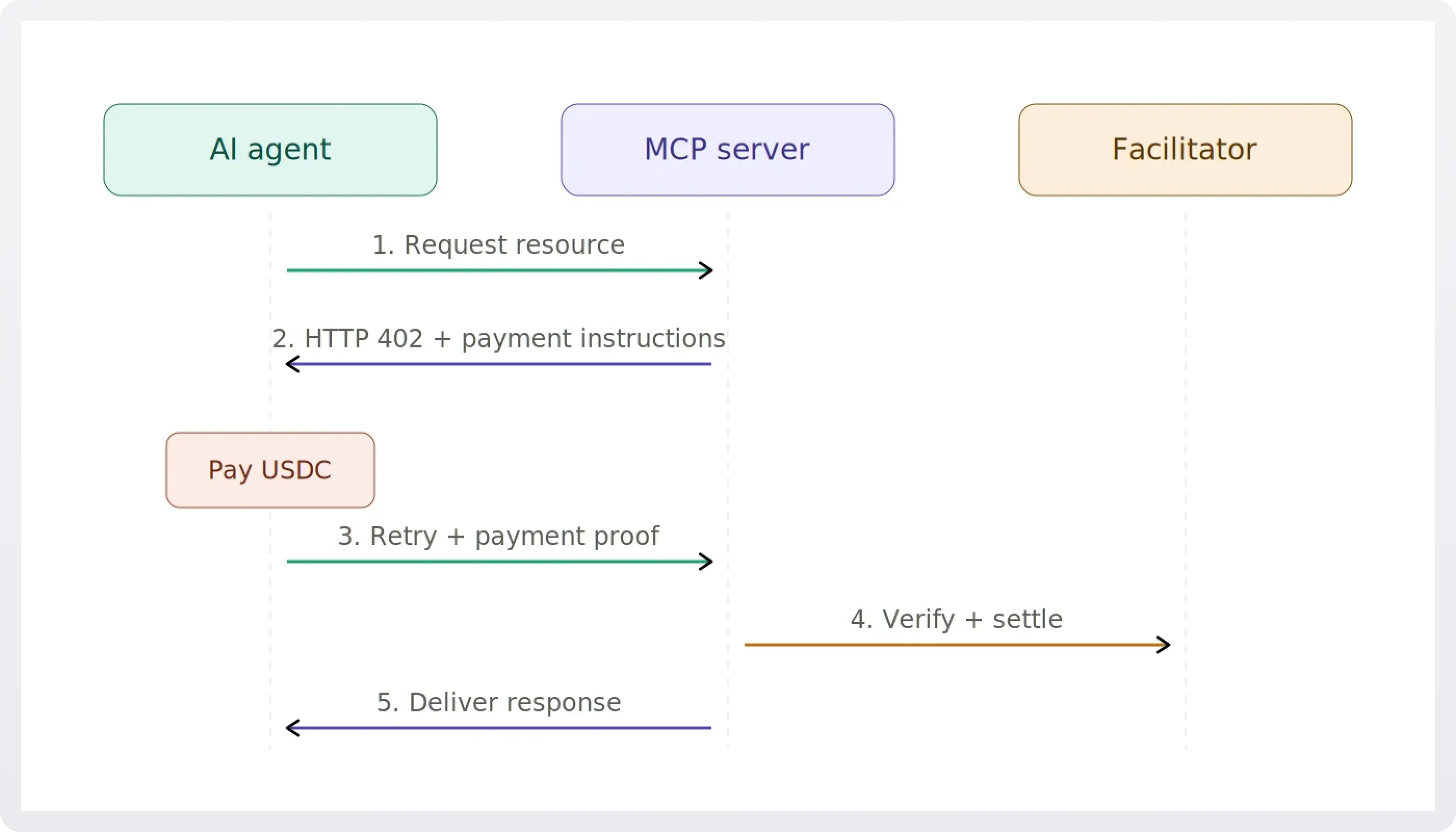
x402 solves this by embedding payment logic directly into the HTTP protocol. Instead of redirecting users to a checkout page or managing complex API tokens for every micro-transaction, x402 allows servers to request payment via the standard HTTP 402 status code. This creates a native, machine-to-machine economy where agents can pay for data, compute, or access instantly and atomically.
However, this efficiency introduces a significant compliance risk. In traditional commerce, identity verification (KYC) and anti-money laundering (AML) checks happen at the point of sale. In agent commerce, transactions are anonymous and automated. Without a native way to enforce compliance, agents could inadvertently facilitate illicit activities or violate financial regulations. x402 endpoints provide the infrastructure to integrate these checks directly into the payment flow, ensuring that autonomous commerce remains secure and compliant by design.
Integrating KYC/AML checks into x402
Embedding compliance into the x402 protocol requires shifting from post-transaction monitoring to pre-transaction validation. Because x402 uses the HTTP 402 status code to gate content delivery, compliance checks must happen before the payment gateway triggers. This approach ensures that only verified agents and users can initiate financial flows, effectively turning the endpoint itself into a regulatory checkpoint.
Define the verification trigger
The first step is determining which endpoints require identity verification. Not every API call involves money; some are free tiers or public data. You must configure your x402 middleware to distinguish between low-risk requests and those requiring Know Your Customer (KYC) or Anti-Money Laundering (AML) screening. For high-value transactions or sensitive data access, the server should return a 402 response that includes a specific payload or redirect URL directing the client to a verification provider. This ensures the agent knows exactly why payment is blocked and where to go to resolve it.
Select a compliant identity provider
Integrating a dedicated identity provider (IdP) is essential for handling the heavy lifting of document verification and sanctions screening. Rather than building custom compliance logic, connect your x402 endpoint to services like Fenergo or Onfido. These providers offer APIs that can validate user identities in real-time. When an agent attempts to pay, your middleware can query the IdP to confirm the user’s status. If the user is verified, the middleware proceeds; if not, it returns the 402 error with instructions to complete verification. This separation of concerns keeps your payment logic clean and compliant.
Structure the 402 response payload
The HTTP 402 response must be structured to include necessary compliance data. Instead of a generic error, include a JSON body that specifies the required action. This might include a link to the verification portal, a reference ID for the compliance check, or specific error codes indicating which AML criteria failed. Agents programmed to handle x402 can parse this payload to automatically redirect users to the verification step. This creates a seamless experience where the payment flow pauses only for verification, rather than failing entirely.
Implement continuous monitoring
Compliance is not a one-time check. Even after an agent pays and accesses content, you must monitor for suspicious activity. Integrate transaction monitoring tools that analyze payment patterns for signs of money laundering. If a verified agent suddenly exhibits high-risk behavior, your system can temporarily suspend their access by returning 402 errors until the activity is reviewed. This continuous loop of verification and monitoring ensures that your x402 endpoints remain compliant with evolving regulatory standards, protecting your platform from legal and financial risks.
Comparing x402 compliance strategies
Integrating KYC/AML checks into x402 endpoints isn't a binary choice. You are balancing the friction of verification against the latency of autonomous agent commerce. The three primary strategies—pre-payment verification, post-payment auditing, and hybrid models—each serve different risk profiles and operational needs.
Pre-payment verification
This approach checks identity and compliance status before the HTTP 402 payment is processed. It is the most secure method for high-stakes transactions, ensuring that only verified entities can initiate a payment. However, it introduces latency, which can disrupt the speed required for autonomous AI agents. This model is best suited for enterprise-level integrations where regulatory certainty outweighs transaction speed. As noted by the x402 ecosystem, this method is specifically designed for transactions involving autonomous AI agents that require transparent risk checks x402.org.
Post-payment auditing
Here, the endpoint accepts the payment first and performs KYC/AML checks after the fact. This minimizes friction and allows for high-frequency, low-value agent interactions without immediate identity bottlenecks. The trade-off is significant risk exposure; if a payment is found to be non-compliant after the fact, reversing it can be complex and legally fraught. This strategy relies heavily on robust internal monitoring and the ability to blacklist or freeze funds retrospectively. Standard AML/KYC principles emphasize that while this reduces user friction, it shifts the burden of compliance to the operational backend Carta.
Hybrid models
Hybrid strategies use tiered verification. Low-risk or low-value transactions proceed with minimal checks, while high-value or suspicious activity triggers full pre-payment KYC. This balances the need for speed with the necessity of compliance. It requires sophisticated logic within the x402 endpoint to dynamically determine the verification level based on transaction size, user history, or risk score. This is often the most practical approach for scaling agent commerce, as it adapts to the context of each interaction.
| Strategy | Compliance Timing | Risk Exposure | Impact on Latency |
|---|---|---|---|
| Pre-payment Verification | Before payment | Low | High |
| Post-payment Auditing | After payment | High | Low |
| Hybrid Models | Dynamic/Tiered | Medium | Medium |
Choosing the right strategy depends on your specific use case. If your agents handle sensitive data or high-value assets, pre-payment verification is non-negotiable. For high-volume, low-value microtransactions, post-payment auditing or a hybrid approach may be more efficient. Always align your compliance strategy with the regulatory requirements of your jurisdiction and the risk tolerance of your business.
Building Secure x402 Endpoints
Securing an x402 endpoint for KYC/AML checks requires more than just accepting crypto; it demands a rigorous API design that treats payment verification and identity validation as inseparable steps. Because these endpoints handle high-stakes agent commerce, the architecture must prevent unauthorized access before any sensitive data or services are exposed.
Authentication and Payment Verification
Every request to your endpoint must first satisfy the x402 payment protocol. The server should reject any request lacking a valid crypto payment signature, ensuring that only paying clients or agents can proceed to the identity verification stage. This acts as a natural rate-limiting and fraud-prevention layer, filtering out malicious actors before they consume resources.
KYC Data Handling
When a client passes the payment check, the endpoint must securely handle KYC documents. Use encrypted channels for transmitting identity proofs and store them using compliant, short-lived retention policies. Never log raw identity data in server access logs, as this creates a liability nightmare. The endpoint should return a simple success or failure token, not the actual document data, to minimize exposure.
Risk Mitigation for Agent Transactions
AI agents operate at scale and speed, making them attractive targets for money laundering. Implement real-time transaction monitoring to flag unusual patterns, such as a single agent making hundreds of small KYC checks. Integrate with reputable AML screening services to cross-reference agent identities against sanctions lists before finalizing the service delivery. This proactive approach keeps your platform compliant and safe.
Essential Implementation Checklist
-
Enforce x402 payment signature validation on every request
-
Encrypt all KYC document uploads in transit and at rest
-
Implement rate limiting based on payment tiers
-
Integrate real-time AML screening for agent identities
-
Log only transaction hashes, never raw personal data
-
Set up automated alerts for unusual transaction patterns
Frequently asked questions about x402
How do I implement KYC checks in an x402 endpoint?
Implement KYC by configuring your x402 middleware to return a 402 status code with a JSON payload containing a verification URL when an unverified agent requests a protected resource. The agent must then redirect the user to your identity provider (e.g., Onfido, Fenergo) to complete verification before resuming the payment flow.
What is the latency impact of pre-payment KYC on AI agents?
Pre-payment KYC introduces latency because the agent must pause execution to complete identity verification. For high-frequency, low-value microtransactions, this may disrupt workflow speed. Consider using hybrid models where low-risk transactions bypass full KYC, reserving pre-payment checks for high-value or sensitive data access.
How does x402 handle AML screening for autonomous transactions?
x402 endpoints can integrate with AML screening APIs to check agent identities against sanctions lists before processing payments. If an agent fails the screening, the endpoint returns a 402 error with specific error codes indicating the compliance failure, allowing the agent to handle the rejection programmatically.
No comments yet. Be the first to share your thoughts!