Set up the x402 payment middleware
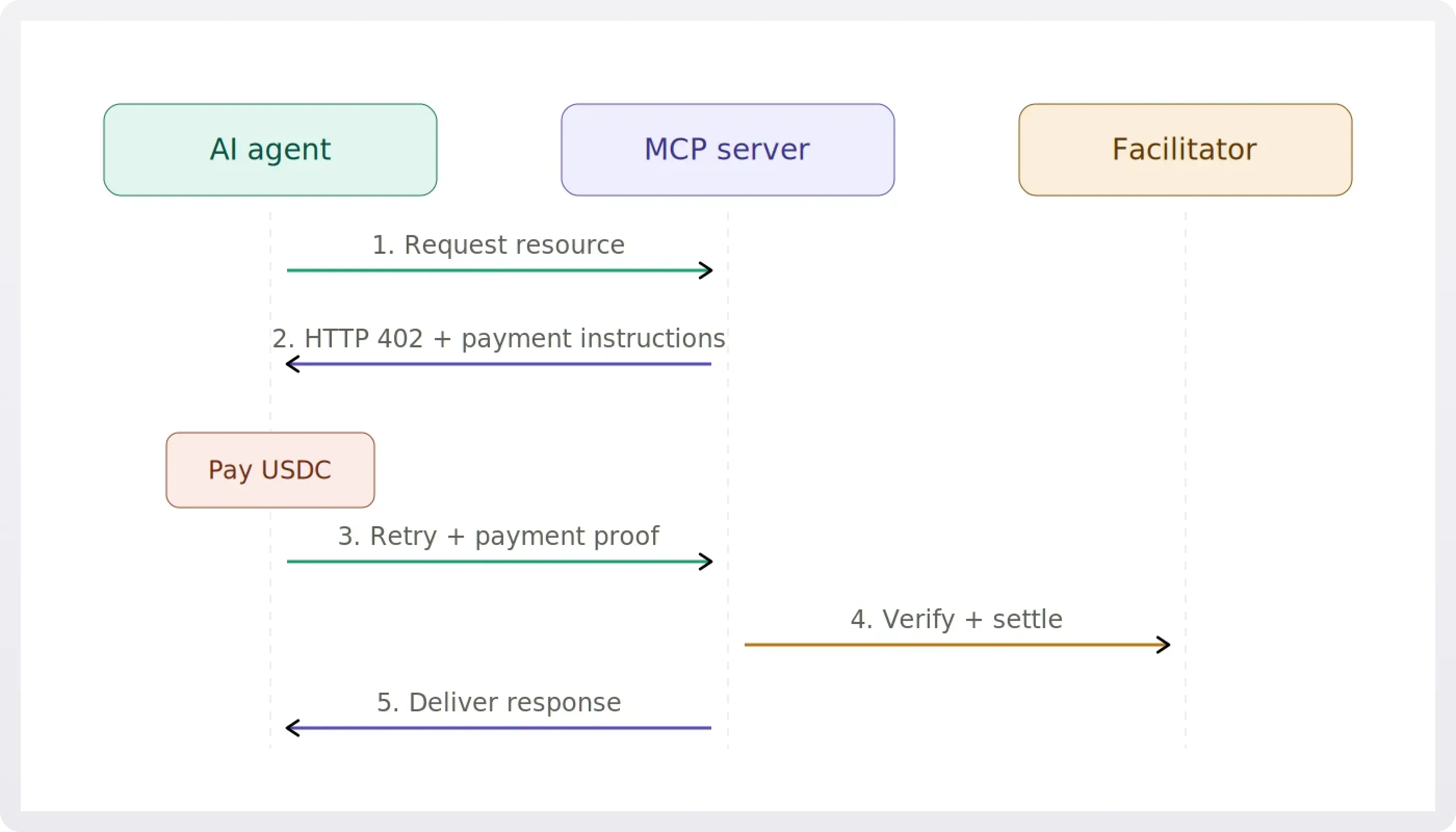
Before layering on KYC and AML checks, you need a working payment pipeline. x402 allows your API to accept payments from buyers and AI agents without managing traditional merchant accounts. The middleware acts as the gatekeeper, verifying that a valid token is presented before your endpoint returns any data.
We will follow the official Coinbase CDP quickstart to establish this baseline. This approach ensures your integration relies on primary documentation rather than third-party tutorials that may become outdated. Once the payment flow is functional, you can wrap it with compliance logic.
Start by adding the official x402 package to your project. This SDK provides the core functions needed to verify payment tokens and manage session states. Run npm install @coinbase/x402 in your terminal to bring the library into your dependencies.
Create a developer account on the Coinbase Developer Platform and generate your API key. Store this key in your environment variables, never in your source code. Your middleware will use this key to authenticate with Coinbase’s payment infrastructure during the token verification process.
Create a middleware function that intercepts incoming requests. This function should extract the x-pay header from the request, pass it to the SDK’s verification method, and reject the request with a 402 Payment Required status if the token is invalid or expired. Only proceed to your business logic if verification succeeds.
Use the SDK’s test tools to simulate a successful payment. Ensure your endpoint returns the expected data when a valid token is presented and correctly rejects requests without one. This step confirms your middleware is ready to handle real transactions before you add identity checks.
With the payment layer active, your API is now capable of accepting crypto payments. The next phase involves inserting KYC/AML checks into this flow, ensuring that only verified users can trigger paid endpoints.
Integrate KYC/AML verification logic
Embedding identity verification into your x402 endpoint logic requires shifting from passive payment acceptance to active compliance enforcement. Instead of treating KYC and AML as post-transaction audits, you validate the user’s identity status before the payment token is even minted or released. This ensures that every x402 transaction originates from a verified entity, satisfying regulatory requirements for customer due diligence (CDD) while maintaining the atomic nature of the payment flow.
By embedding these checks directly into the x402 endpoint logic, you create a payment flow that is both compliant and efficient. Users who are verified and clean experience seamless transactions, while non-compliant activities are stopped at the source.
Compare compliance and payment providers
Choosing the right infrastructure depends on whether your x402 endpoints serve autonomous AI agents or human users. The x402-secure protocol is specifically designed for transactions involving autonomous AI agents, integrating pre-payment risk checks directly into the transaction flow. However, integrating these checks requires a compliance partner that understands both cryptocurrency rails and traditional KYC/AML standards.
Not all providers offer the same level of integration depth. Some focus on basic identity verification, while others provide full AML screening and transaction monitoring. Below is a comparison of three common provider types to help you evaluate fit for your specific use case.
Traditional payment gateways often lack native x402 support, requiring complex workarounds that can break the seamless payment-for-content model. Crypto-native providers may offer API access but often lack the depth of AML screening required for high-risk jurisdictions. Providers integrated directly with x402-secure are built to handle the unique challenges of AI agent transactions, including transparent risk scoring and pre-payment checks.
When evaluating providers, look for those that explicitly mention support for autonomous agents or API-driven identity verification. This ensures your endpoints can programmatically enforce compliance without interrupting the user or agent experience.
Test endpoints with real payment schemes
Before pushing to production, you need to verify that your KYC/AML checks hold up under actual transaction conditions. Testing with live payment schemes ensures your API can handle the complexity of compliance without breaking the user experience.
Run exact and up-to-date transactions
Start by sending individual requests that mimic real-world usage. Use the exact parameters your production environment expects, including updated KYC tokens and AML flags. This step confirms that your endpoint correctly validates identity and risk scores for single transactions.
Send a single request with valid KYC credentials and an approved AML status. Verify the API returns a 200 OK with the expected payment token. This confirms your basic integration path is secure and compliant.
Use the most recent KYC verification tokens to ensure your system accepts current data. Rejected tokens or expired AML checks should trigger appropriate error responses (401 or 403). This step validates that your endpoint respects the freshness of compliance data.
Send a batch of transactions to simulate high-volume load. Monitor your logs for any dropped KYC checks or latency issues. This ensures your compliance layer can scale without becoming a bottleneck during peak times.
Verify compliance under load
Finally, run a checklist to ensure everything is ready for launch. This includes confirming that all error paths are logged and that your system can handle rejected transactions gracefully.
Avoid Common Integration Mistakes
Even with a clear roadmap, small oversights can break compliance or block legitimate users. The most frequent errors in x402 KYC/AML integration usually stem from skipping validation steps or misconfiguring risk thresholds. Fixing these early saves significant debugging time later.
Skip Facilitator URL Validation
Many developers assume the KYC/AML facilitator endpoint is always stable. It isn't. If your x402 endpoint doesn't validate the facilitator URL before sending sensitive data, you risk sending PII to a dead or compromised address. Always verify the endpoint returns a valid 200 OK with the expected schema before proceeding. This check acts as your first line of defense against data leakage.
Misconfigure Risk Checks
Setting risk thresholds too high or too low creates two distinct problems. Low thresholds block legitimate users, hurting conversion rates. High thresholds let high-risk transactions slip through, inviting regulatory scrutiny. Start with conservative limits and adjust based on your specific transaction volume and user base. Don't guess; use data from your pilot phase to tune these settings.
Ignore Cross-Border Nuances
If your x402 API handles international payments, generic KYC/AML checks might not be enough. Regulations vary significantly by jurisdiction. A user passing checks in one country might fail in another due to different sanction lists or beneficial ownership rules. Ensure your integration can handle these variations by checking for region-specific requirements before finalizing the transaction.
Frequently asked questions about x402 compliance
How does x402 handle identity verification?
x402 integrates KYC/AML checks by requiring identity verification before allowing transactions. This process typically involves customer due diligence (CDD) to confirm who is sending and receiving funds, ensuring compliance with financial regulations while maintaining the integrity of the payment flow.
Can x402 protect user privacy during checks?
Yes. x402 supports zero-knowledge proofs (ZKPs), which allow users to prove they meet compliance requirements without revealing sensitive personal data. This balances regulatory adherence with privacy, ensuring that only necessary verification data is shared with the API endpoint.
What happens if a transaction fails compliance?
If an x402 endpoint detects a non-compliant transaction, it will reject the payment request. The API will return an error code indicating the specific compliance failure, allowing developers to handle the rejection gracefully or request additional verification from the user.
No comments yet. Be the first to share your thoughts!