Why agent commerce needs x402
Traditional payment rails were designed for human-driven transactions, not the high-frequency, machine-to-machine interactions that define agent commerce. When an AI agent needs to purchase data, compute power, or verification services, it faces the latency of traditional card networks and the friction of manual authentication flows. More critically, legacy systems lack native hooks for compliance. An agent cannot simply "verify identity" in a way that satisfies Know Your Customer (KYC) and Anti-Money Laundering (AML) requirements without breaking the automation loop.
x402 solves this by activating the HTTP 402 status code for programmatic payments. Instead of a separate checkout flow, the payment gate is embedded directly in the protocol layer. When an agent requests a resource, the server responds with a PaymentPayload. The agent must sign and submit this payload to receive the 200 OK response. This structure allows compliance checks to be part of the transaction logic itself, ensuring that only verified, compliant agents can access sensitive data or services.
This integration is vital for high-stakes environments where regulatory clarity is paramount. As noted in legal analyses of the protocol, the convergence of stablecoin settlement and regulatory frameworks has created the conditions for HTTP 402 to move from theoretical to practical. For developers, this means replacing fragile workarounds with a standardized, auditable payment flow that respects both security and compliance mandates.
To understand the efficiency gains, compare the settlement finality of x402 transactions against traditional credit card processing. While card settlements can take days and incur chargeback risks, x402 leverages blockchain finality for near-instant, irreversible confirmation.
Setting up the payment middleware
The bridge between your API gateway and the blockchain settlement layer relies on a specific middleware configuration. This setup ensures that every request for sensitive KYC or AML data triggers an HTTP 402 challenge before any identity information is revealed. The process involves installing the necessary dependencies and wiring the payment handler to validate the incoming request.
Start by installing the core x402 packages in your project directory. These dependencies provide the cryptographic primitives required to generate and verify the PaymentPayload. Without these libraries, your server cannot construct the valid signatures needed to initiate a settlement.
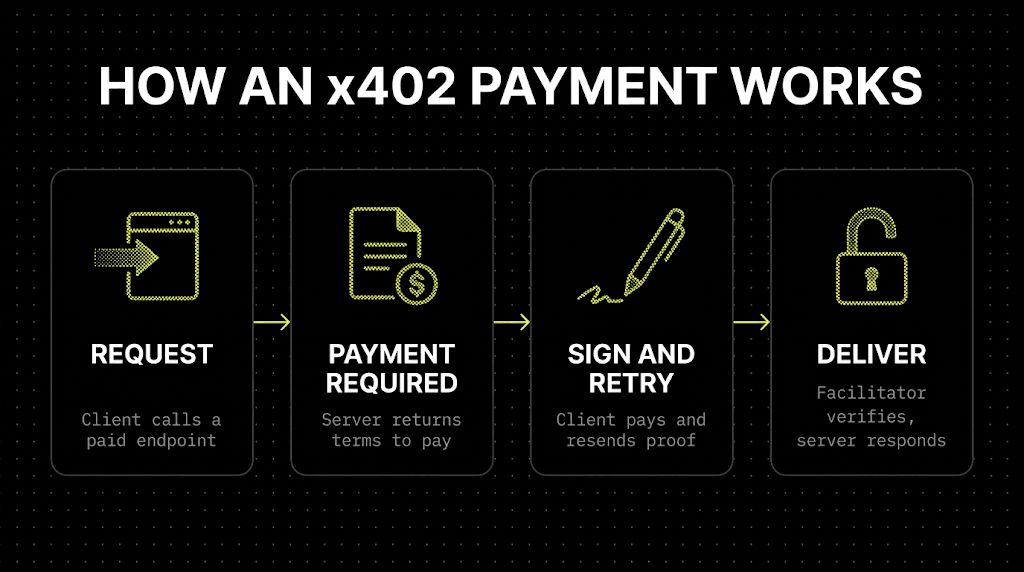
Once installed, configure your HTTP handler to intercept requests. When a client asks for a KYC check, the middleware should reject the request with a 402 status code, including the required payment parameters in the response headers. The client must then sign the PaymentPayload and resubmit the request with the valid signature. Only after the signature passes verification does the middleware proceed to fetch the compliance data from your backend.
This flow creates a secure, atomic transaction. The user pays for the service exactly when they access the data, and the settlement occurs on-chain, providing an immutable record of the transaction for audit purposes.
Embed KYC/AML Logic into the x402 Flow
Integrating KYC/AML checks into the x402 protocol requires shifting verification from a post-transaction audit to a pre-condition gate. In this model, the PaymentPayload cannot be finalized until the agent confirms the user’s identity status. This approach aligns with the "Verify Customer Identities" principle outlined in compliance frameworks, ensuring that regulatory screening happens before value transfer occurs.
The process follows a strict sequence: collect identity data, screen against regulatory lists, and validate the result before issuing the HTTP 402 challenge. If the screening fails, the payment token is withheld entirely.

The agent first requests specific identity attributes from the user, such as name, date of birth, and government ID. This data is structured into a temporary verification object. The agent must ensure this data is encrypted in transit and stored only long enough to perform the screening check, minimizing liability under data protection regulations.
Once collected, the identity data is passed to an AML screening engine. This engine checks the user against global sanctions lists (OFAC), politically exposed persons (PEP) databases, and adverse media feeds. This step corresponds to the "Customer Due Diligence" phase required by standard onboarding protocols. The agent waits for a pass/fail response before proceeding.
If the screening returns a clean status, the agent updates the PaymentPayload to include a verification token or signature. The agent then triggers the HTTP 402 response, signaling that the payment gateway can now accept the transaction. If the screening fails, the agent returns a specific error code indicating compliance refusal, and no payment token is generated.
| Feature | Manual KYC | x402-Gated |
|---|---|---|
| Timing | Post-transaction audit | Pre-transaction gate |
| Automation | Low (human review) | High (API-driven) |
| User Friction | High (separate portal) | Low (embedded flow) |
This embedded logic ensures that compliance is not an afterthought but a structural requirement of the payment flow. By gating the PaymentPayload on verified identity, developers create a system that is both efficient and regulatory-compliant by design.
Generate the signed PaymentPayload
With the KYC and AML checks successfully validated, the final step is to construct the PaymentPayload. This payload serves as the cryptographically signed proof that the buyer has met the compliance requirements and is ready to settle the invoice. Unlike standard API responses, this object must contain specific metadata required by the x402 specification to ensure the payment gateway can verify the transaction integrity without re-querying your compliance database.
When building the PaymentPayload, ensure you include the unique transaction ID, the timestamp of the compliance check, and the signature generated by your private key. This signature is critical; it prevents tampering by ensuring that no third party can alter the compliance status or the associated payment amount after the fact. According to the Coinbase Developer Documentation, proper signing of the payment payload is essential for the buyer’s agent to successfully route the payment through the x402 network.
Once the payload is signed, return it to the client as an HTTP 402 response. This status code signals that the service is available but requires payment to proceed. The buyer’s agent will parse this payload, verify the signature against your public key, and then execute the payment. By keeping the compliance verification and payment settlement tightly coupled in this flow, you maintain a clear audit trail that satisfies regulatory requirements while minimizing latency for the end user.
Common kyc and aml: what to check next
When integrating x402 endpoints, compliance logic often feels like a black box. By understanding the core pillars and stages, you can structure your PaymentPayload to satisfy regulatory requirements without blocking legitimate users.
No comments yet. Be the first to share your thoughts!