Why Agent Commerce Needs x402
The rise of autonomous AI agents has created a new layer of the internet economy, one where machines trade data, compute power, and verification services without human intervention. For this system to function, it requires a payment rail that is both machine-readable and programmable. Traditional payment infrastructure was built for human-centric commerce, relying on heavy-handed gatekeepers, recurring subscription models, and manual fraud checks that are too slow and costly for microtransactions between agents.
The core problem is that existing financial rails cannot natively handle the velocity and volume of agent-to-agent interactions. When an AI agent needs to pay for a KYC check or an AML screening, it does so via API calls that happen in milliseconds. Legacy banking systems and even basic crypto wallets lack the standardized protocol to attach payment instructions directly to the request. This creates a friction point where the cost of the transaction infrastructure often exceeds the value of the service itself.
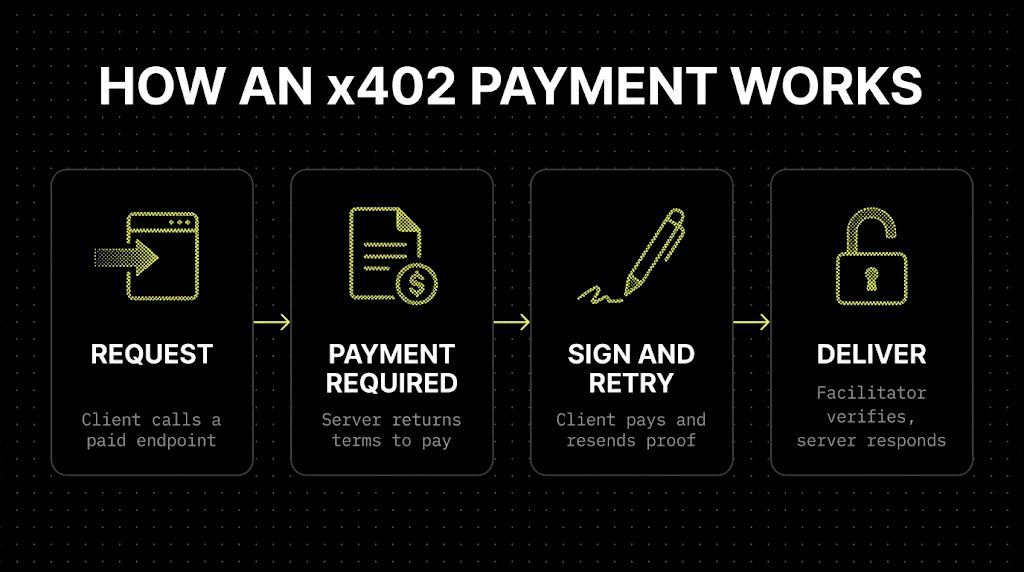
x402 solves this by embedding the payment logic into the HTTP protocol itself. It allows an API to respond with a 402 Payment Required status, carrying specific payment instructions that an agent can process automatically. This shifts the burden of compliance and payment from a post-transaction reconciliation process to a pre-transaction gate. For KYC/AML providers, this means payments are secured before sensitive data is accessed, reducing risk and administrative overhead.
However, this automation does not eliminate regulatory obligations. As noted by legal experts, x402 is a new front-end for the same underlying BSA/AML and sanctions risks. The protocol facilitates the transfer of value, but it does not absolve the parties involved from performing due diligence. Instead, it provides a technical framework that can be integrated with compliance checks, ensuring that every transaction is both paid and vetted in a single, automated step.
Setting up the x402 payment layer
Integrating x402 into your KYC/AML workflow begins with establishing the technical foundation. The protocol relies on standard HTTP mechanics, specifically the 402 Payment Required status code, to gate access to sensitive identity verification endpoints. By configuring your server to recognize and issue these responses, you ensure that no verification data is processed until the associated agent or service settles the fee.
Install dependencies and initialize the gateway
First, install the client libraries that handle the payment protocol logic. Most implementations wrap standard HTTP requests with middleware that intercepts the response code. If the endpoint returns a 402, the client automatically triggers the payment flow rather than throwing a generic error. This separation keeps your compliance logic clean and isolated from payment handling.
npm install @x402/client
Once installed, initialize the gateway with your provider credentials. This step connects your API to the blockchain network where transactions are settled. Ensure you configure the wallet or agent identity that will be used to sign and broadcast payments. Misconfiguring this identity can lead to failed transactions or unauthorized access attempts.
Configure the HTTP 402 response mechanism
Your server must be configured to return a 402 status when a request lacks valid payment proof. Include a Payment-Required header that specifies the exact amount and currency needed. This header guides the client to the correct payment path. Without this explicit instruction, the client may not know how to proceed or may attempt to pay the wrong amount.
res.writeHead(402, {
  'Payment-Required': '0.01 USDC',
  'Payment-Uri': '/pay/kyc-check'
});
res.end('Payment required for verification');
Verify the integration with a test call
After configuration, run a test request against your endpoint. Expect a 402 response initially. Then, simulate a payment using your testnet credentials. The server should process the transaction and return the KYC/AML result once the payment is confirmed. This cycle validates that your gateway correctly interprets payment signals and releases data only when authorized.

Run your package manager to install the necessary dependencies. This provides the core functions for handling payment requests and responses.
Set up your server to intercept API calls. Configure the middleware to check for payment status before allowing access to KYC endpoints.
Implement the logic to return HTTP 402 with appropriate headers. This ensures clients know exactly what is needed to proceed.
Send a test request and verify the 402 response. Then, complete the payment and confirm the endpoint returns the verification data.
Final integration checklist
-
Dependencies installed and imported
-
Gateway initialized with correct credentials
-
402 response handler configured with headers
-
Test payment flow verified on testnet
-
Error handling for failed transactions in place
Embed identity verification before payment triggers
The x402 protocol automates agent-to-agent commerce, but it does not automatically verify who is on the other side of the transaction. You must embed KYC (Know Your Customer) and AML (Anti-Money Laundering) logic into your API flow to ensure compliance before the payment trigger occurs. Without this guardrail, an autonomous agent could inadvertently facilitate transactions with sanctioned entities or high-risk actors.
Think of this verification layer as a toll booth that must clear every vehicle before it enters the highway. The x402 endpoint handles the payment, but your integration must handle the identity. This means calling verification APIs early in the request lifecycle, blocking or flagging transactions if the risk assessment fails, and only then proceeding to the x402 payment request.
Choosing the right verification approach
Not all KYC checks are created equal. Your choice between real-time and batch verification depends on your latency requirements and risk tolerance. Real-time checks provide immediate feedback, essential for high-frequency agent interactions, while batch processing is more cost-effective for lower-risk, high-volume transactions.
The table below compares common verification methods based on latency, cost, and coverage to help you decide where to place your checks.
| Method | Latency | Cost | Coverage |
|---|---|---|---|
| Real-time API | < 2 seconds | Higher per check | Global sanctions & PEPs |
| Batch Screening | Minutes to hours | Lower volume pricing | Historical data & lists |
| Document Verification | 3-5 seconds | Medium | Identity proofing |
| Biometric Liveness | 2-4 seconds | Higher | Fraud prevention |
Implementing the logic
To integrate this effectively, structure your API so that identity verification is a prerequisite for payment authorization. Start by implementing a Customer Identification Program (CIP) to collect basic identity data. Then, run this data through a Customer Due Diligence (CDD) check to assess risk levels.
If the risk score exceeds your threshold, block the transaction. If it falls within acceptable limits, proceed to the x402 payment endpoint. This ensures that your agent commerce platform remains compliant with regulations like the Bank Secrecy Act and FATF recommendations, without sacrificing the speed of automated transactions.
Validating on-chain settlement logic
When integrating x402 endpoints for KYC/AML checks, the security of the transaction hinges on the PaymentPayload. This signed data structure acts as the primary verification layer, ensuring that the buyer authorizes the specific compliance check and the associated stablecoin payment. By cryptographically signing the payload before it leaves the client, you prevent malicious facilitators from altering the request or stealing funds mid-transit.
The validation process is straightforward: the receiver verifies the signature against the buyer’s public key and checks the on-chain settlement directly. Because the payment is settled directly on-chain via the signed payload, there is no intermediary holding the funds in escrow. This architecture removes the risk of a third-party processor misrepresenting the settlement status or absconding with the capital.
From a regulatory standpoint, this technical structure maps cleanly to existing BSA/AML obligations. The x402 protocol serves as the front-end interface for these underlying risks, meaning the same KYC/AML and sanctions screening (OFAC) applies as it would in traditional fiat transactions. The difference lies in the transparency: every signed payload provides an immutable, verifiable trail of who authorized the payment and for what purpose, simplifying the audit process for compliance officers.
Common x402 kyc/aml integration: what to check next
Developers integrating x402 for regulated transactions often face specific compliance hurdles. Below are the most frequent technical concerns regarding data handling, verification failures, and settlement integrity.
For detailed protocol specifications, refer to the official x402 documentation.
No comments yet. Be the first to share your thoughts!