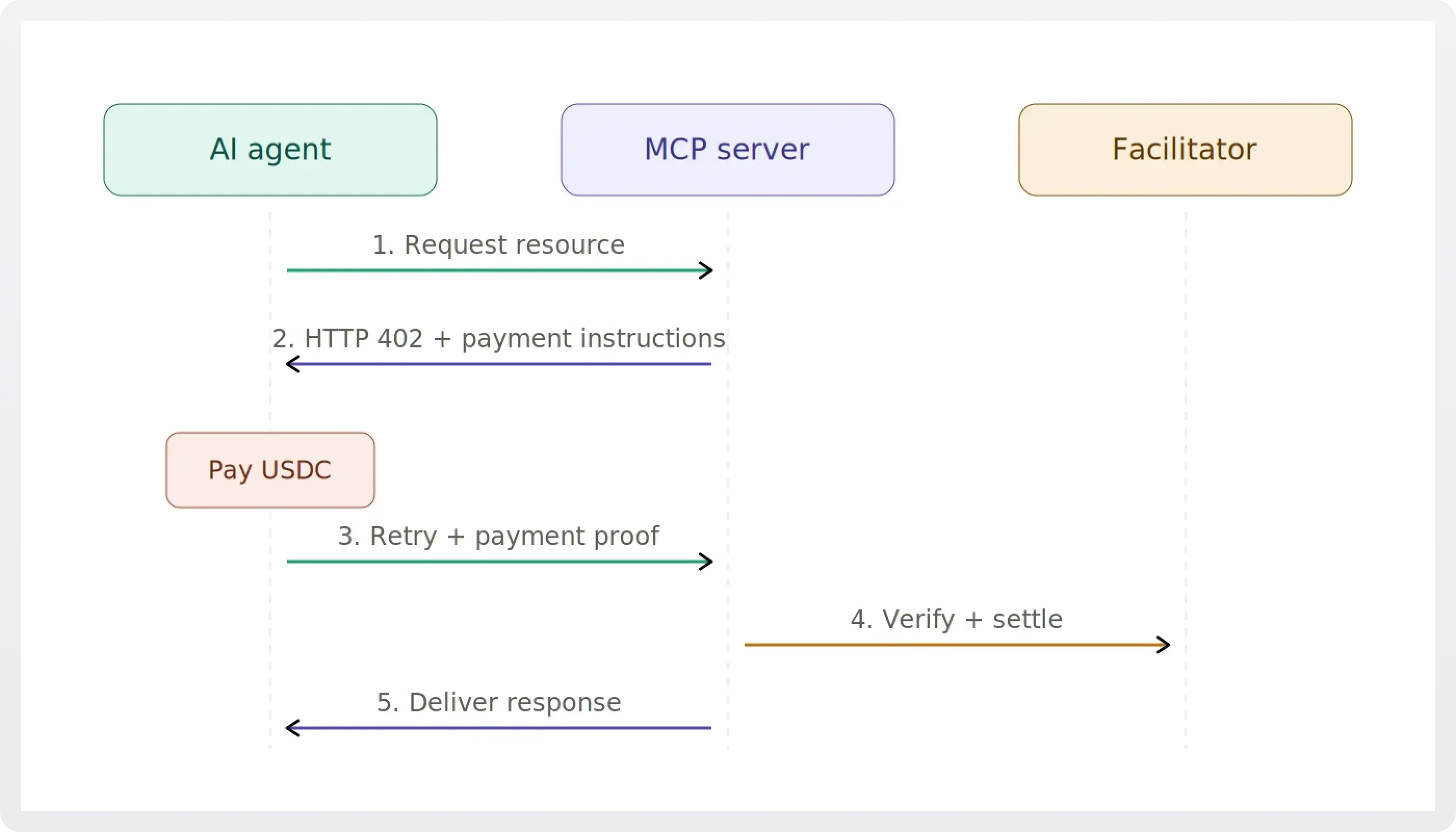
Why x402 fits agent commerce compliance
KYC and AML verification is inherently expensive. Compliance providers incur real costs to run checks against databases, yet they face a persistent risk: an agent might request a report, consume the sensitive data, and then fail to pay. This "free rider" problem has historically made it difficult to automate high-stakes compliance in agent-to-agent commerce, where trust is low and volume is high.
x402 solves this by introducing atomic settlement. Unlike traditional payment flows where payment and service delivery are separate events, x402 ensures they happen simultaneously. The compliance provider only releases the verification data at the exact moment the payment is confirmed on-chain. This eliminates the risk of non-payment for the provider and ensures the requesting agent only pays for verified, delivered results.
For developers, this means you can build automated compliance workflows without building complex escrow systems or invoicing logic. The protocol handles the guarantee. As noted in the official x402 introduction, this open payment standard is designed to help developers integrate services where payment is a prerequisite for access x402 Docs. This alignment of financial and data security is what makes x402 uniquely suited for regulatory checks.
Set up the x402 payment middleware
To integrate x402 for KYC/AML checks, you need a facilitator that bridges your API with blockchain settlement. This middleware handles the payment logic, ensuring that stablecoin transactions are verified before your service processes sensitive identity data. By using a provider like Coinbase CDP or Thirdweb, you offload the complexity of wallet management and transaction monitoring.
The core advantage here is atomic settlement. The payment and the service delivery happen in a single, verifiable step. This eliminates the risk of non-payment for high-value compliance checks and provides a clear audit trail for regulatory purposes.
1. Choose your facilitator
Select a provider that supports ERC-20 stablecoins, primarily USDC. Coinbase CDP offers a streamlined integration for developers already in the Coinbase ecosystem, while Thirdweb provides a more universal SDK approach. Both support the x402 specification, which allows your API to accept payments directly via HTTP headers.
2. Configure the payment endpoint
Update your API routes to recognize x402 requests. The facilitator provides a library that intercepts incoming requests, verifies the payment signature, and checks the transaction status on-chain. If the payment is confirmed, the request proceeds; otherwise, it returns a 402 Payment Required error.
3. Set up USDC integration
Ensure your facilitator is configured to accept USDC on the appropriate network (e.g., Base, Ethereum, or Polygon). Most KYC/AML providers prefer stablecoins to avoid price volatility during the check process. Configure the contract address and network ID in your facilitator's environment variables.
4. Verify transaction settlement
The middleware must confirm that the transaction is settled on-chain before releasing the KYC/AML report. This step is critical for compliance. Use the facilitator's verification function to check the transaction hash against the blockchain explorer. Only release the data once the confirmation count meets your threshold.
5. Handle edge cases
Implement logic for failed transactions or insufficient funds. If a payment is rejected, provide a clear error message that includes the payment hash for support inquiries. This helps users resolve issues quickly and maintains a smooth experience for compliance officers who may need to audit failed attempts.
6. Test with a sandbox
Before going live, use the facilitator's sandbox environment to simulate payments. This allows you to verify that your API correctly processes x402 headers and that the KYC/AML check triggers only after payment confirmation. Test with small amounts to ensure the flow is seamless.
Compare settlement models for verification
When building x402 endpoints for KYC/AML checks, the way you structure payment directly impacts your operational efficiency. Unlike traditional fiat gateways that bundle fees, x402 enables atomic settlement, meaning the payment and the compliance result happen in the same transaction. This atomicity is the key differentiator, but it also means you need to choose a settlement model that matches your specific compliance workload.
The three main schemes—Exact, Upto, and Batch—offer distinct trade-offs between cost predictability and integration complexity. Exact pricing is straightforward but rigid. Upto pricing allows for dynamic billing based on actual processing time, which is useful for variable data sources. Batch processing handles high-volume identity verification by grouping requests, reducing per-unit overhead but introducing latency.
To help you decide which model fits your use case, the table below breaks down the core differences in cost structure, implementation effort, and ideal scenarios.
| Model | Cost Structure | Integration Complexity | Ideal Use Case |
|---|---|---|---|
| Exact | Fixed price per check | Low | Standard ID verification with predictable data sources |
| Upto | Variable based on processing time | Medium | Deep background checks with variable data retrieval times |
| Batch | Volume-based discount | High | High-volume onboarding with pre-approved applicants |
Map x402 Endpoints to the Compliance Lifecycle
KYC and AML compliance is not a single event but a continuous cycle: verify identity, assess risk, monitor transactions, and report suspicious activity. x402 endpoints act as the gatekeeper for this entire lifecycle, allowing you to embed regulatory checks directly into the payment flow. By treating compliance as a prerequisite for atomic settlement, you ensure that funds only move when the necessary regulatory conditions are met.
Identity Verification
The first gate is verifying who is sending the funds. Instead of routing users to a third-party portal, you can call an identity verification endpoint before initiating the transaction. If the endpoint returns a success status, the payment proceeds. If it fails, the x402 protocol blocks the settlement, preventing the transfer of assets to an unverified address. This keeps the user experience seamless while ensuring your platform meets basic "Know Your Customer" requirements.
Risk Assessment
Once identity is confirmed, the next step is assessing the risk level of the counterparty. You can integrate a risk scoring API that evaluates the sender’s history against sanction lists or high-risk jurisdictions. The x402 endpoint can require a specific risk score threshold as part of the payment payload. If the risk score is too high, the endpoint rejects the transaction, effectively freezing the funds until a manual review is completed.
Transaction Monitoring
Continuous monitoring is essential for detecting unusual patterns. x402 allows you to attach metadata to each transaction, which can be used to flag anomalies in real-time. For example, if a transaction exceeds a certain volume or frequency, the endpoint can trigger a hold, requiring additional verification before settlement. This transforms compliance from a retrospective audit into a proactive, real-time control mechanism.
Reporting
Finally, when suspicious activity is detected, you need a clear audit trail. Since x402 transactions are recorded on-chain, you have an immutable record of every compliance decision. You can integrate your reporting tools to automatically generate Suspicious Activity Reports (SARs) based on the data captured by your x402 endpoints. This ensures that your reporting is accurate, timely, and fully aligned with regulatory obligations.
Choose a payment scheme for KYC settlement
Selecting the right settlement model depends on your agent commerce volume and risk tolerance. Unlike traditional banking rails that batch transactions, x402 enables atomic settlement—where the payment for the KYC check settles simultaneously with the compliance result.
This atomicity is the key differentiator. It eliminates counterparty risk for both the agent and the compliance provider. If the KYC check fails, the payment never finalizes. This logic is particularly valuable for high-volume agents who need to manage cash flow without tying up capital in pending compliance holds.
Evaluate your settlement options
Per-check atomic settlement is the standard for most x402 implementations. Each API call triggers a discrete, on-chain transaction. This model offers the highest transparency and is ideal for low-to-medium volume agents who prioritize auditability over transaction fees.
Batched settlement is an emerging pattern for high-throughput systems. Here, multiple KYC checks are aggregated into a single settlement transaction. While this reduces gas fees, it introduces a slight delay in finality. Use this only if your volume justifies the complexity and your risk model can tolerate the batch window.
The decision framework
- Low volume, high compliance need: Stick to per-check atomic settlement. The overhead is minimal, and the audit trail is clean.
- High volume, cost-sensitive: Consider batched settlement to optimize gas costs, but ensure your middleware can handle reconciliation errors.
- Cross-border agents: Atomic settlement reduces FX risk by locking the price at the moment of the check, avoiding volatility during processing delays.
For most developers, starting with per-check atomic settlement is the safest path. It aligns with the x402 spec’s core promise: a direct, trustless exchange of value for verified identity data.
No comments yet. Be the first to share your thoughts!